Showing posts with label 2010. Show all posts

2010 Nissan Sports Cars GT-R by Tommy Kaira

2010 Nissan Sports Cars GT-R by Tommy Kaira
They have been teasing this car 2010 Nissan Sports Cars GT-R by Tommy Kaira for a long time, but now just in time for 2010 Tokyo Auto Salon it is ready to be unveiled. This is one of the finest body kits we’ve seen for the mighty GT-R so far. We know that Japanese tuner’s Tommy Kaira finished the early stage of their Nissan GT-R plan for the launch at the 2010 Tokyo AutoSalon. This Kyoto based tuner, who is known to have  started out by modifying Mercedes car is now all focused on GT-R as it brings out the Silver Wolf Nissan GT-R from its stable.
2010 Nissan Sports Cars GT-R by Tommy Kaira
Called the Silver Wolf, this 2010 Nissan Sports Cars GT-R by Tommy Kaira comes with a full body kit, plus new rolling stock, brakes, exhaust and suspension components. The carbon fiber widebody package gives the GT-R a serious attitude adjustment. Two kit choices are available, the first being a very comprehensive one while the second just works on the front end.
2010 Nissan Sports Cars GT-R by Tommy Kaira
With no change to GT-R’s twin-turbo V6 engine, 2010 Nissan Sports Cars GT-R by Tommy Kaira has just got some fabulous interior work and upgraded breaks, exhaust and suspension systems. Carbon and red leather interior will give it’s driver a very luxuries feel while the carbon fiber widebody of the silver wolf still keep it  decent and stylish. Tommy Kaira has well managed to keep its name in the auto industry and it is expected that the Japanese icon will not compromise on the performance of their new GT-R project. So until there is some final testing on the Fuji Speedway, check out the greatest performance car more closely in the pictures below.
The 2010 Nissan Sports Cars GT-R by Tommy Kaira full kit consists of, among others, a wet carbon front bumper, a front grille cover, lip spoiler, under diffuser, side ducts and side skirts. The rear also features wet carbon in the form of a racing diffuser, a rear wing and rear fender extensions. The AVS Model F15 Platinum black wheels are shod with Pirelli P-Zero 255/40R20 and 285/35R20 front and rear tyres respectively.
2010 Nissan Sports Cars GT-R by Tommy Kaira

2010 Hamann Super Sports Cars Victory II

2010 Hamann Super Sports Cars Victory II
German tuning house Hamann, Hamann Victory is presented based on the super sports cars Lamborghini Gallardo first, and its latest projected, dubbed the Victory II, is a prime example.
Based off the Lamborghini Gallardo LP560-4, the 2010 Hamann Super Sports Cars Victory II features a completely new look thanks to all new body panels, functional roof inlet, rear wing and 20-inch Hamann wheels. The car body becomes broader and the engine performance as well as the amount of carbon parts is significantly increased.
2010 Hamann Super Sports Cars Victory II
Hamann car equips the Victory II with 20 inch Edition Race rims with a special varnish in order to emphasize the new dynamic look. At the same time, the reduced unsprung masses improve the handling and the acceleration and braking response. The recommended wheel/tyre combination is 9.5Jx20 inches with 235/30ZR20 tyres at the front and 13Jx20 rims with 325/25ZR20 tyres at the back.
The back of the car is enhanced by a diffuser and a newly designed rear wing which pushes the car onto the road at high speeds. Hamann offers the rear wing either in fibre glass or the ultra light and persistent carbon. On top of that, a carbon layer can be applied to the bonnet.
With the LP560-4 already producing 552 bhp and 398 lb-ft torque, Hamann decided to do only minor modifications to the 5.2L V10. New engine programming results in 20 more horsepower and an additional 26 lb-ft, resulting in a new top speed of 204 mph. Therefore, the 2010 Hamann Super Sports Cars Victory II reaches an impressive 328 km/h top speed. The impressive V10-Sound turns even more remarkable by applying an end muffler to the serial end pipes.
2010 Hamann Super Sports Cars Victory II
The interior of the 2010 Hamann Super Sports Cars Victory II is enhanced by a 14-part carbon set which includes decorative blends, the steering wheel and the door openers. The Hamann-sports seats with the carbon back render a perfect seating position.
2010 Hamann Super Sports Cars Victory II

2010 BMW Sports Cars Z4 GT3

2010 BMW Sports Cars Z4 GT3
The German company BMW has been considered as one of the top manufacturers ever since it was first introduced in 1916, they have been an expert when it comes to creating new and innovative vehicles to cater to the market. GT3 BMW Z4, which is officially launched and completed the first test drive in early March, already enjoying great popularity among customers of BMW Motorsport. The first cars delivered to private teams, BMW will prepare them for use in national and international championships.
2010 BMW Sports Cars Z4 GT3
BMW Z4 production model is impressive: with a long hood, wheel arches are lit, the long wheelbase and narrow projection, this car offers a unique look. BMW Motorsport engineers two passengers provide a good basis to develop close to GT3 racing car production.
“Information about the 2010 BMW Sports Cars Z4 GT3 very positive,” said BMW Motorsport Director Mario Theissen. ‘Round these sports cars in the range of our products, and provides drivers and teams a chance to compete at the championships in accordance with the GT3 regulations – such as the FIA GT3 European Championship, the International GT Open or Masters ADAC GT – and 24-hour endurance races." In addition, the BMW M3 GT2, the BMW 320si WTCC, which complies with Super2000 regulations, and the close-to-production BMW M3 GT4 are also available to customer teams from all over the world at BMW Motorsport Distribution.
2010 BMW Sports Cars Z4 GT3
The largest difference between production and racing car can be found under the bonnet: while the production version of the BMW Z4 is driven by a six-cylinder engine, the GT3 car is powered by a 4.0-litre eight-cylinder engine similar to the unit used in the BMW M3 GT2. This powerful heart produces over 480 bhp. Its excellent performance characteristics and good torque curve make the base engine from the production version of the BMW M3 predestined for use in motorsport.
Front and rear wings, bonnet, roof, fender and many other components are made of carbon fibre reinforced plastics (CFRP). Using this lightweight, torsion-resistant material contributed significantly to reducing the weight of the 2010 BMW Sports Cars Z4 GT3 to 1,200 kilograms. As with all cars in the BMW customer racing range, the emphasis was also put on cost-efficiency when developing the 2010 BMW Sports Cars Z4 GT3. As a result, the car offers an excellent cost / quality ratio and gives the team a chance to participate personally in the affordable sports car at the highest level.
2010 BMW Sports Cars Z4 GT3
The BMW Z4 GT3 is available as a racing version is available from the second quarter of 2010 at an estimated price of 298,000 Euro (plus VAT).

2010 Lotus Sport Cars T127 Formula One

2010 Lotus Sport Cars T127 Formula One
Lotus has just unveiled its 2010 Formula 1 car, after 15 years one of the most successful names in Formula One returns to the grid with the launch of the Lotus T127. Backed by the Malaysian government, the new Lotus team will field two cars, driven by Jarno Trulli and Heikki Kovalainen. Lotus the T127 will be one of several cars using the latest Cosworth V8 this year.
2010 Lotus Sport Cars T127 Formula One
2010 Lotus Sport Cars T127 Formula One Racing is backed by the Malaysian Government - where Lotus owner Proton is based - securing the rights last year to the team's name and legendary green and yellow colours. Mike Gascoyne, technical chief for the T127, admitted the car was designed very quickly, the team revealing its car mere weeks ahead of the 2010 Bahrain F1 Grand Prix.
The Lotus T127 is powered by a Cosworth engine - another name returning to the sport cars after an extended absence - and will use an Xtrac transmission, in line with all 2010 teams, will be running on Bridgestone tyres.
2010 Lotus Sport Cars T127 Formula One

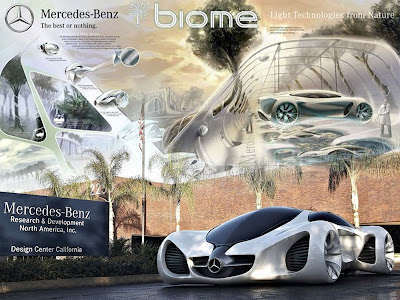
2010 Mercedes-Benz Sport Cars Biome Concept

2010 Mercedes-Benz Sport Cars Biome Concept
Born out of the 2010 LA Auto Show’s Los Angeles Design Challenge, in which automotive designers are given free range to envision the future of transportation, the Biome is meant to blend seamlessly into the planet’s ecosystem. That means all components of the 2010 Mercedes-Benz Sport Cars Biome Concept car are “grown” organically, and it emits pure oxygen and is fully compostable at the end of its service life.
2010 Mercedes-Benz Sport Cars Biome Concept
The basis for the Biome Concept is a vehicle that "grows in a completely organic environment from seeds sown in a nursery." Not only that, but it's powered by a combination of the sun and a chemical bond from an imaginary liquid dubbed BioNectar4534. It's all natural, all organic and all science fiction.
"As the inventor of the motor car, we wanted to illustrate the vision of the perfect vehicle of the future, which is created and functions in complete symbiosis with nature. The Mercedes-Benz BIOME is a natural technology hybrid, and forms part of our earth's ecosystem. It grows and thrives like the leaves on a tree" according to Hubert Lee, Head of the Mercedes-Benz Advanced Design Studios in Carlsbad.
2010 Mercedes-Benz Sport Cars Biome Concept
This year the competition had called for the creation of a vision of a safe and comfortable 2+2 compact car featuring good handling and a first-class design, and weighing only 1,000 lbs (around 454 kg/kerb weight).
The 2010 Mercedes-Benz Sport Cars Biome Concept symbiosis vehicle is made from an ultralight material called BioFibre and tips the scales at just 875.5 lbs (around 394 kg). This material is significantly lighter than metal or plastic, yet more robust than steel. BioFibre is grown from proprietary DNA in the Mercedes-Benz nursery, where it collects energy from the sun and stores it in a liquid chemical bond called BioNectar4534.
2010 Mercedes-Benz Sport Cars Biome Concept
The 2010 Mercedes-Benz Sport Cars Biome Concept is powered by BioNectar4534, which is stored in the BioFibre material of the chassis, interior, and wheels. In addition, Mercedes-Benz has developed a technology to equip trees with special receptors which can collect the excess solar energy and turn it into BioNectar4534. This creates a direct link with nature's energy sources and acts as an incentive to cover mobility energy requirements through more trees and at the same time maintain natural resources.
The Los Angeles Design Challenge is part of the Design Los Angeles conference, taking place from 17 to 18 November 2010 as part of the Los Angeles Auto Show.
2010 Mercedes-Benz Sport Cars Biome Concept

2010 Volvo Sport Cars Air Motion Concept

2010 Volvo Sport Cars Air Motion Concept
At the Los Angeles Design Challenge Competition, Volvo took the open-air experience at a whole new level with its ‘lighter than a Formula 1 racing car’ study project – the Volvo Air Motion. Besides its strong yet ultra-light body structure, the Air Motion concept cars vehicle further adds to its superlatives eco-friendliness, as it is not using a single drop of gasoline while driving wild.
Volvo Air Motion is a sports cars that runs on powerful, yet simple compressed air motors that, unlike an internal combustion engine, cools down under load rather than heat up. The air tank is centrally mounted and receives compressed air through wind-powered air replenishment sites that float 1000ft in the air. Its beautiful Scandinavian body is designed like a clam shell and sculptured from ultra light carbon fiber.
2010 Volvo Sport Cars Air Motion Concept
Tipping the scales at under 1,000 pounds (453 kg), the Volvo Air Motion Concept is lighter than a Formula One car and employs a similar open-wheel configuration.
2010 Volvo Sport Cars Air Motion Concept
The 2010 Volvo Sport Cars Air Motion Concept was developed around the idea that minimizing the weight and complexity means maximizing driving enjoyment. Volvo built the cars with fewer components and replaced the heavy internal combustion engine with powerful, yet simple, compressed air motors.
To compress the air needed for the centrally mounted air tank, Air Replenishment Sites are used. Powered by air turbines floating 1,000ft in the air they harness the power of the wind and convert it to electricity to provide the compression. The motors cool down with increased load, instead of heating up, which eliminates the need for cooling systems. The chassis, interior and suspension employ an integrated design which brings a notable contribution to the lowered weight.
Aimed at the driving enthusiast, by a company synonymous with safety and environmental care, the Volvo Air Motion Concept demonstrates the beauty and purity of Scandinavian design and delivers a guilt free, raw driving experience.
2010 Volvo Sport Cars Air Motion Concept

2010 Lotus Sport Cars Elan Concept

2010 Lotus Sport Cars Elan Concept

At Paris Auto Show 2010 Lotus automaker manufacture has display six new models super car sport. One of the six models is the Lotus Elan Concept. 2010 Lotus Elan Concept Cars, a high performance sports car, is the beating heart of the new Lotus line-up and thanks to some clever innovations the Lotus Elan also has everyday usability too.
2010 Lotus Sport Cars Elan Concept
Elan is expected to go to production in summer of 2013 and will be available for purchase in fall of 2013. Like the Evora, the Lotus Elan features 2+2 seating, suggesting that the new Evora may not really have a long life at Lotus. Prices for the production Elan are estimated to start around $118,500 ( £75,000 ).
Lotus Elan Concept Power is provided by a mid-mounted 4.0-liter V6 engine with 450 PS (331 kW / 444 hp) and 465 Nm (343 lb-ft) of toque. It is backed up by a seven-speed DCT transmission, which enables the 1,295 kg (2,855 lb) car to accelerate from 0-100 km/h in 3.5 seconds and hit a top speed of 310 km/h (193 mph). If that fails to attract your attention, perhaps you’ll be interested in the hybrid variant which will have CO2 emissions as low as 199 g/km. With performance specs like that, there's a little double that Elan is supercar.
From a styling perspective, the Elan is built like an athlete with a muscular physique and perfect poise. It’s a thoroughbred, rigid with tension, ambitious and addictive, nothing but best in class will suffice for this car.
It’s not enough to simply provide performance and exceptional looks, innovation is also integral to the Elan’s appeal. In keeping with the rest of the new Lotus range, the Elan features optional hybrid technology with KERS.
2010 Lotus Sport Cars Elan Concept
Dany Bahar, Chief Executive Officer of Group Lotus, said: “If there was ever a car to make you drive the long way home, it’s the Elan. Perfect for both road and track, the Elan not only ticks all the boxes, it creates new ones too.”
“The Elan will convert people to Lotus, I would challenge people not to become addicted to driving it. It will also go a long way towards dispelling the old misconceptions about this class, that in order to have high performance you must sacrifice usability – those days are gone.”
“Once you drive an Elan you won’t look back, it will give you things you didn’t even realise you were missing – that’s the essence of Lotus and the Elan perfectly captures that spirit.”

2010 Lotus Sport Cars Elan Concept