2011 CR Z Honda Hybrid Sport Car Coupe

2011 CR Z Honda Hybrid Sport Car Coupe

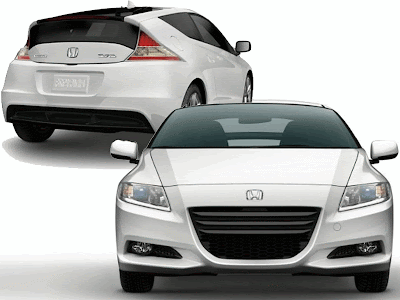
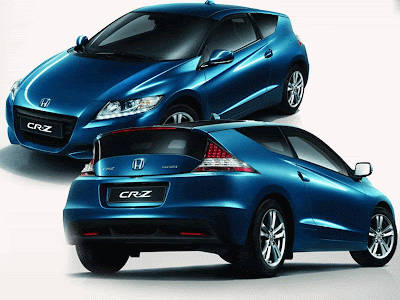
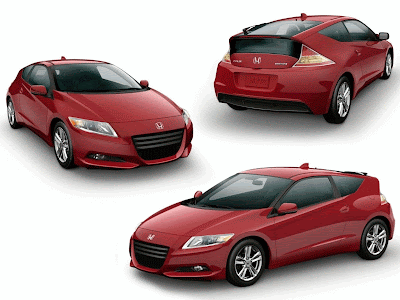
The all-new 2011 Honda CR-Z sport hybrid coupe, making its U.S. production debut at the North American International Auto Show in Detroit, introduces sleek styling and sporty handling to the hybrid segment, American Honda Motor Co., Inc., announced today.
John Mendel, executive vice president of sales for American Honda, said "The CR-Z is a personal sport hybrid coupe for people with a spirit of adventure and an elevated sense of responsibility toward the environment, it's the first hybrid designed to maximize style and fun, in addition to efficiency and economy."
2011 CR Z Honda Hybrid Sport Car Coupe 

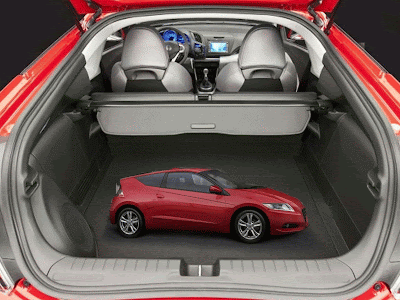
Set to go on sale late summer in the U.S., the CR-Z is powered by a 1.5-liter i-VTEC engine with Honda's compact and lightweight Integrated Motor Assist (IMA) hybrid-electric system. The two-passenger CR-Z introduces a new three-mode drive system that allows the driver to select between Sport, Econ (Economy) and Normal driving modes. The two trim levels include the well-equipped CR-Z and the feature-rich CR-Z EX. A six-speed manual transmission is standard equipment and a Continuously Variable Transmission (CVT) is available. Standard features on the CR-Z include Vehicle Stability Assist, an AM/FM/CD/USB audio system with six speakers, automatic climate control, power windows and door locks, remote entry, cruise control, and more. The CR-Z EX adds, High-Intensity Discharge (HID) Headlights with Auto-On/Off, fog lights, a 360-Watt AM/FM/CD premium audio system with seven speakers including subwoofer, Bluetooth® HandsFreeLink®, perforated leather-wrapped steering wheel, and more. The CR-Z EX is available with the Honda Satellite-Linked Navigation System1 with voice recognition.
2011 CR Z Honda Hybrid Sport Car Coupe 

The foundation of the 2011 Honda CR-Z Sport Hybrid Coupe’s hybrid powertrain is a 4-cylinder, 16-valve, single overhead cam engine with “intelligent” Variable Valve Timing and Lift Electronic Control (i-VTEC) that receives additional power from the IMA system’s DC brushless electric motor. The system delivers a combined peak output of 122 horsepower2 at 6,000 rpm and 128 lb-ft. of torque2 at 1,000 to 1,500 rpm (123 lb-ft on CVT-equipped models). The Honda CR-Z Sport Hybrid Coupe standard six-speed manual transmission is engineered for optimal acceleration performance in gears one through five and for optimal fuel economy in sixth gear.
2011 CR Z Honda Hybrid Sport Car Coupe 

The CR-Z's three-mode drive system allows the driver to select between individual modes of performance for Sport, Normal and Economy driving styles. The system is activated via three backlit buttons to the left of the steering wheel.
The Sport mode enhances multiple vehicle systems for performance including the engine throttle responsiveness, electric power steering effort and the electric motor power assist. The inner ring of the tachometer illuminates red when the vehicle is in Sport mode.
2011 CR Z Honda Hybrid Sport Car Coupe 

During Econ mode operation, the engine's responsiveness is tuned for optimal economy, the electric motor assist gives priority to fuel efficiency and the air conditioning system can reduce its overall load on the engine. The inner ring of the tachometer transitions between blue and green when the vehicle is in Econ mode, with the green representing more ecological driving.
2011 CR Z Honda Hybrid Sport Car Coupe

Normal mode provides standard settings for steering, engine response, motor assist and air conditioning. Similar to Econ mode, the tachometer ring transitions between blue and green when the vehicle is in normal mode, with the green representing more ecological driving. Like the Honda Insight, the CR-Z offers an Eco Guide and Eco scoring feature to help drivers track progress of efficient driving styles.

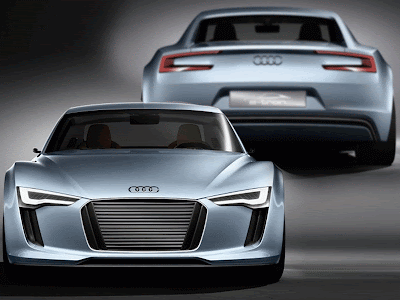
2010 Audi e-tron Sports Car Concept with "MMI touch"

2010 Audi e-tron Sports Car Concept
 The Detroit Audi e-tron Concept is 3.93 meter (154.72 in) long and 1.78 meter (70.08 in) wide but just 1.22 meter (48.03 in) tall two-seater; just a few months after the debut of the Audi e-tron Concept at the 2009 Frankfurt Motor Show, this is now the second electric concept vehicle from the brand with the four rings. Audi is showing an uncompromising purist compact sports car with all-electric drive at the 2010 NAIAS. Lithium-ion batteries, located for an optimal center of gravity behind the passenger compartment and ahead of the rear axle, make an effective energy content of 45 kilowatt-hours available. This makes an operating range of up to 250 kilometers (155.34 miles) realistically possible. 

2010 Audi e-tron Sports Car Concept

Coupled with the Detroit Audi e-tron Concept's low gross weight of around only 1,350 kilograms (2976.24 lb), high-torque power units driving the rear wheels guarantee commensurate road performance. Two electric motors with a combined output of 150 kW (204 hp) and 2,650 Nm (1954.54 lb-ft) accelerate the coupe with ASF-design aluminum body from 0 to 100 km/h (62.14 mph) in just 5.9 seconds. The Audi e-tron Concept accomplishes the sprint from 60 to 120 km/h (37.28 - 74.56 mph) in a mere 5.1 seconds.
As previously with the first Audi e-tron Concept car shown in Frankfurt, Audi again bases all components in this electric vehicle on an integral concept with many revolutionary details: a heat pump as an efficient means of heating up and maintaining the interior temperature. The drive system, power electronics and battery have innovative thermal management - crucial for maintaining a high operating range coupled with outstanding interior comfort.
2010 Audi e-tron Sports Car Concept 

The two electric motors, which have their own cooling system, are mounted on the rear axle. This special package, featuring a 40:60 weight distribution, ensures perfect balance, which contributes to the driving dynamics of the Audi e-tron Concept.
The trapeze of the single-frame grille dominates the distinctly wedge-shaped front end and is flanked by two large air intakes. The top of the grille merges into the flat strips of the adaptive matrix beam headlight modules with their clear glass covers. All light units use ultra-efficient LED technology.
One design element that is specific to electric vehicles developed by Audi - such as the Audi e-tron - are the air intakes in the single-frame grille and behind the side windows on the C-post. They are closed flush under normal circumstances and opened by retracting slats when additional cooling air is required. The slats above the drive unit then also open to provide a better through-flow of air. These measures, too, maximize efficiency - the concept car is outstanding for an already low drag coefficient that is further improved when the flaps are closed.
2010 Audi e-tron Sports Car Concept 

The combination of aluminum and carbon fiber-reinforced composite material guarantees supreme rigidity coupled with low weight. Audi will soon use this technology in a similar form for future production vehicles. Despite the complex drive system layout with two electric motors and a high-capacity battery system, the total weight of the Audi e-tron Concept on display in Detroit is only around 1,350 kilograms (2,976.24 lb).
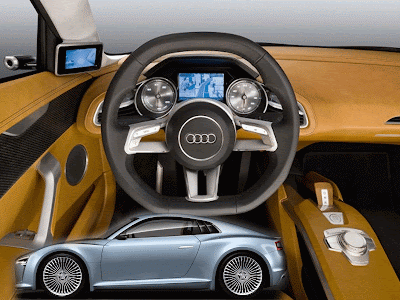
The MMI is controlled via a scroll pad with a touch-sensitive surface on the steering wheel ("MMI touch") - an element inspired by modern smartphones. The steering wheel itself is clearly flattened off at both the top and bottom, in a clear reference to motor sport.
A smartphone that can be integrated into the front section of the center console interfaces between the vehicle, the driver and external information sources. The driver can use a suitably equipped conventional smartphone as a car phone, address database, navigation system and video player. At the same time they can also use it as an operating unit for many specific on-board systems in the Audi e-tron Concept. Many phones that are suitable for these functions are already available from various manufacturers.
2010 Audi e-tron Sports Car Concept 

Characteristic for the concept of the Audi e-tron - and therefore also characteristic for a further development in an electric vehicle - is the near total elimination of switches and small components such as the ignition. The climate control unit is located to the right above the steering wheel. The display provides temperature and ventilation information. Again drawing inspiration from a smartphone, the system is controlled by means of a touch-sensitive sliding control.

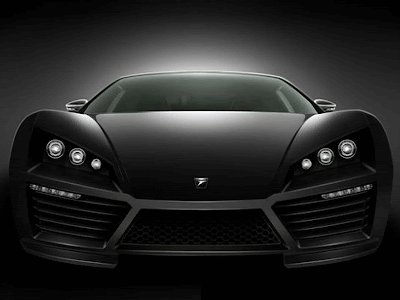
Fenix Supercar ultra-powerful mid-engined V8 Announced By Lee Noble

Fenix Supercar ultra-powerful mid-engined V8
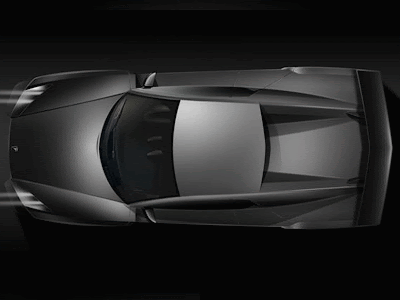
Lee Noble’s love for cars remains as young as it used to be. I can say so because even when he left the company he built, Noble, his newest creation, Fenix supercar. Leicestershire – Lee Noble, the maverick designer and engineer who has defined the British low volume sports car market in recent years, is back in the hot seat of an all-new company, Fenix Automotive Limited, and is due to launch one of the most dramatic supercars of the century next year. 
Fenix Supercar ultra-powerful mid-engined V8
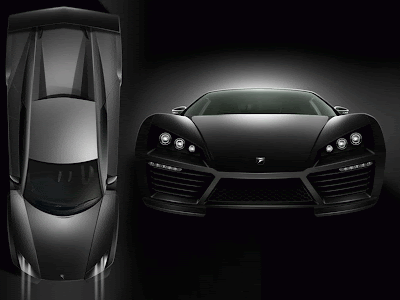
Fenix supercar is believed to be the sequel of the iconic M12 which was a great success but Fenix is a start from the scratch as far as the designing part is concerned. Fenix will be having two models for the grab whereby GM`s 480bhp LS3 V8 will be the `base` unit, while the 6.2-litre supercharged LS9 V8 will provide customers with a 638bhp power option. And powered with 638bhp engine, as Fenix claims, car will get from 0-100mph in less than seven seconds and go on to reach more than 200mph.
 Fenix Supercar ultra-powerful mid-engined V8
With successful production cars like the Noble M12 and M400 already under his belt (as well as the original Ultima and Ascari, among many others) Lee is investing his vast experience in delivering a lightweight, ultra-powerful mid-engined V8 supercar to market by the end of 2010.
“Our new car will offer buyers performance and dynamics that they’d normally have to spend well over £100,000 to experience, but at a far more affordable price,” said Lee Noble. “It will combine simplicity, strength and agility, while its two-seat, closed body will ensure sensible levels of refinement for road use.

 Fenix Supercar ultra-powerful mid-engined V8
With over 25 years’ experience in the low volume sports car market, Lee’s pragmatic approach to producing super-fast, giant-killing cars has won him credibility among buyers and the media alike. So while the first pictures of his new creation (due early next year) are sure to cause a stir, Lee’s grounded philosophy to manufacturing will ensure that the car is a production reality. In fact, development of the car began in earnest a year ago, and the first prototype, which will be used to validate the all-new chassis and powertrain, is currently being built in Port Elizabeth, South Africa, in the same plant that produced all the M12s.
Fenix Supercar ultra-powerful mid-engined V8
Fenix supercar’s first edition will be launched in UK in the second half of the year whereas its prototype is under construction in South Africa. Lee believes that he can roll out 100 editions a year and it will cost somewhere around £70,000 per unit.

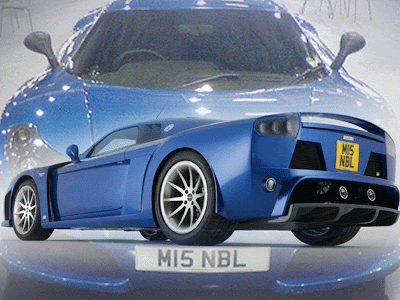
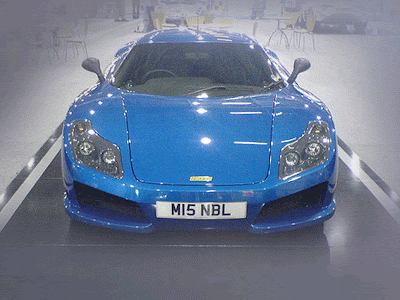
Fenix Supercar M14 and M15 a New Noble Supercar

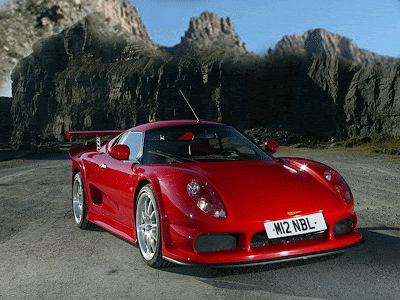
Fenix Supercar M14
Although the man has been separated from the company that bears his name for a while now, as we revealed when PH interviewed Lee Noble before Christmas he's still hard at work in the business of producing sports cars. Despite having left his namesake British supercar company Noble Automotive, Lee Noble is back in the game and plans to begin development on an all-new supercar.
His new company is called Fenix Automotive and the first Fenix is planned to be a lightweight, mid-engine coupe that can capture a sub-seven-second 0 to 100 mph. The car will feature a powerful V8 engine and is intended to be ‘one of the most dramatic supercars of the century’ thanks in part to the moderate price tag of 75,000 pounds (app. $125K). Noble also mentioned an interesting feature that will make the first Fenix practical both on road and track, though apparently didn’t elaborate from there.

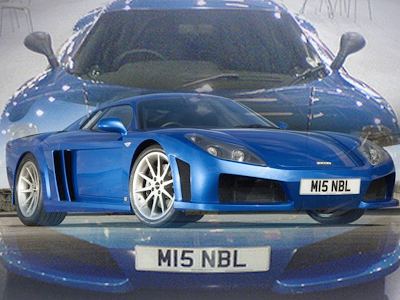
Fenix Supercar M15

The Fenix supercar prototype is currently in build at Fenix's facility in South Africa, and the car will do its initial hot-weather testing there before heading to the UK for further development.
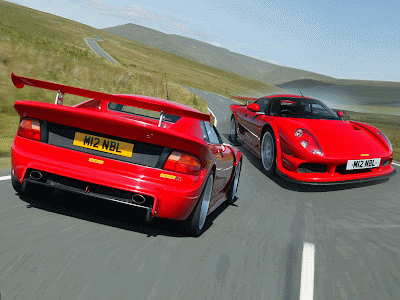
"The M12 was hugely successful, but we needed to move the game on in terms of design," says Noble. "The new car's styling owes nothing to what I've done before and has quite literally been a 'clean sheet' exercise from the start. It's edgy, with powerful lines, and aerodynamically will be in another league to any of my previous cars."
 Fenix Supercar M15

But despite Noble's protestations of a clean-sheet design, we can't help but think of the Fenix as the hoped for successor to the sharp, focused, track-honed M12 series, and that's no bad thing. That the looks seem to bear a passing resemblance to the stillborn M14 and M15 is far from a tragedy, too. The Fenix will be powered by an LS3 GM V8 pumping out 480bhp, while the truly power hungry can specify the 638bhp LS9 V8 as seen in the Corvette ZR1. Fenix reckons that the LS9-engined car should accelerate from 0-100mph in under seven seconds and hit a maximum of 200mph.
 Fenix Supercar M15

"I always said I wanted to build a car with the performance of an Enzo for less than £100k, and that's what I'll deliver this time round," said Noble when we interviewed him, and it looks like he might manage it. The base model is expected to cost around £70k, with the supercharged version set to come in at less than £100k.